
RFID Read Range vs. Read Reliability: What Really Matters in RFID Performance?
RFID read range is often one of the first specifications considered when evaluating an RFID tag. A longer reading distance may appear to indicate better performance, particularly when comparing tags designed for similar applications.
However, maximum read range alone does not determine whether an RFID tag will perform reliably in an actual operating environment. A tag that can be detected at a considerable distance under controlled conditions may not deliver consistent results when installed on products, surrounded by other materials, or exposed to changing orientations.
For industrial and commercial RFID applications, read range and read reliability are two closely related but distinct aspects of RFID performance. Understanding both is essential for selecting suitable tags, configuring reading systems, and evaluating whether an RFID deployment can meet operational requirements.
Understanding RFID Read Range
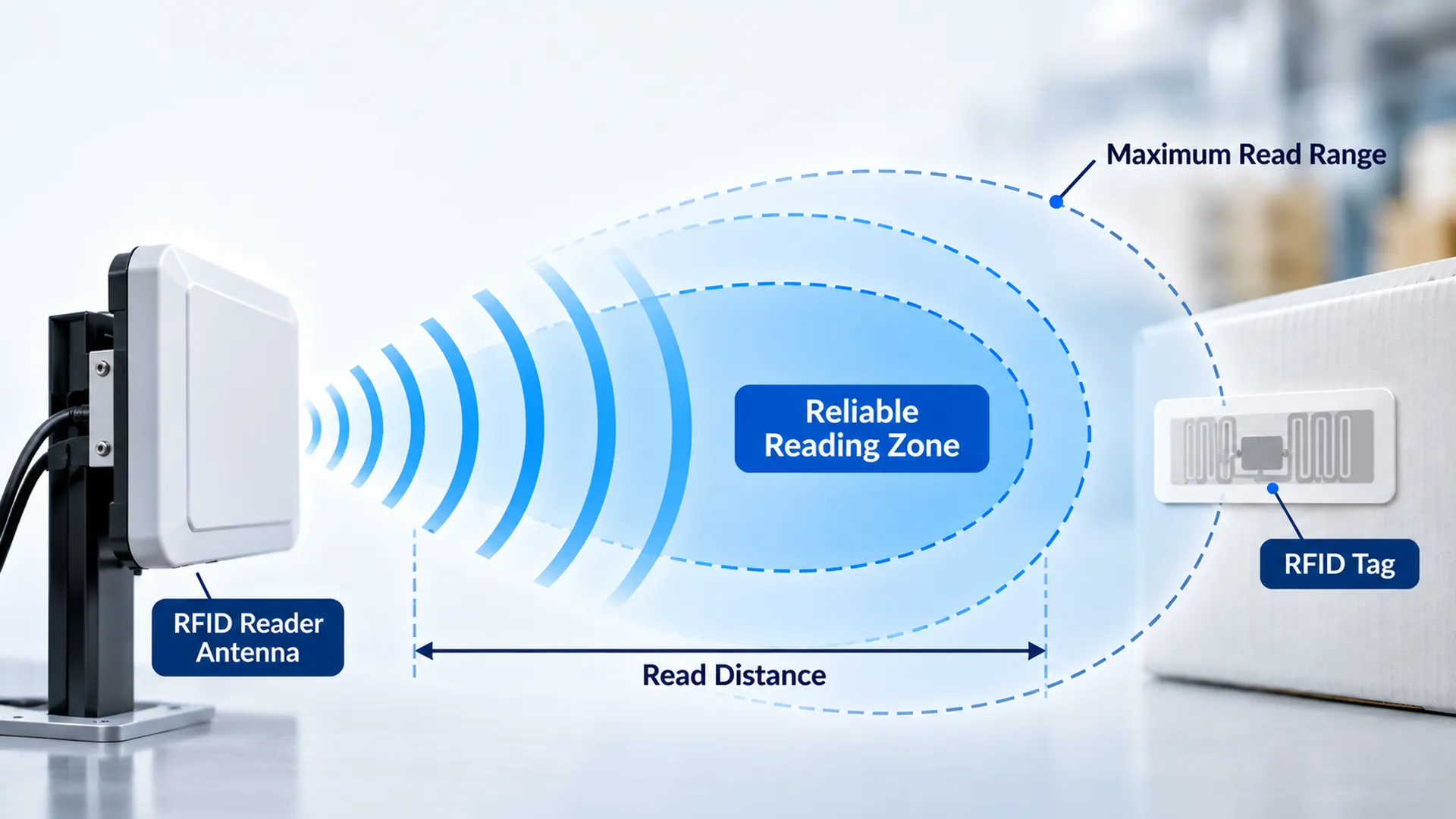
RFID read range refers to the distance over which an RFID reader can successfully communicate with a tag under specified conditions.
For passive UHF RFID systems, the achievable reading distance depends on several interacting factors, including the RFID chip’s sensitivity, tag antenna design, reader transmission power, antenna gain, polarization, and surrounding environment.
Because passive RFID tags do not contain an internal power source, they rely on energy received from the reader’s electromagnetic field. The tag must receive sufficient energy to operate, while the reader must also be able to detect and decode the tag’s backscattered response.
This means that read range is influenced by both the forward communication link from the reader to the tag and the return link from the tag to the reader.
Maximum Read Range vs. Effective Read Range
Maximum read range generally describes the greatest distance at which a tag can be successfully read under a particular set of test conditions.
These conditions may include favorable tag orientation, limited interference, controlled antenna positioning, and an environment with minimal surrounding materials.
Effective read range, by contrast, describes the distance or operating region within which a tag can meet the required reading performance for a specific application.
For example, a tag may be detectable at 10 meters under favorable conditions but provide more consistent results at shorter distances when attached to actual products or used in a production environment. This is an illustrative example rather than a specification for any particular tag.
Neither measurement is inherently incorrect. They serve different purposes.
Maximum read range is useful for understanding the potential capability of an RFID tag, while effective read range is more relevant when determining whether the tag can support a particular reading process.
A meaningful read range specification should therefore be considered together with its test conditions and intended application.
What Is RFID Read Reliability?
RFID read reliability describes how consistently a tag, or a population of tags, can be successfully identified under defined operating conditions.
While read range answers the question of how far a tag can be read, read reliability addresses whether the required reading result can be achieved repeatedly and consistently.
Reliability can be evaluated in different ways depending on the application.
For an individual RFID tag, testing may focus on the proportion of successful identification attempts at a specified distance, orientation, and reader configuration.
For batch-reading applications, reliability may be measured by the percentage of expected tags successfully identified within a defined reading period.
For automated processes, the evaluation may also consider whether tags are consistently detected as items move through a reading zone at normal operating speeds.
These measurements are related, but they are not interchangeable.
Read Range vs. Read Reliability: Key Differences
Although closely related, read range and read reliability describe different aspects of RFID performance. The following comparison highlights their respective roles in RFID evaluation.
| Evaluation Aspect | Read Range | Read Reliability |
|---|---|---|
| Primary Question | How far can the tag be read? | How consistently can the tag be identified? |
| Main Focus | Communication distance | Successful identification under defined conditions |
| Typical Measurement | Maximum or effective reading distance | Successful-read rate or identification completeness |
| Testing Conditions | Distance, orientation, reader settings, environment | Repeated reads, tag population, operating time, environmental variations |
| Practical Significance | Determines potential reading coverage | Determines whether the required identification process can be completed consistently |
Read Reliability Is Application-Dependent
There is no single read reliability percentage that can describe RFID performance across every application.
A stationary inventory-reading process may allow multiple reading attempts, while a conveyor-based identification process may provide only a limited time for each item to be detected.
Similarly, an application involving a small number of well-separated tags has different requirements from one involving hundreds of closely packed items.
The definition of a successful read must therefore be established before reliability can be meaningfully evaluated.
In practical RFID deployments, reliability is not simply a characteristic of the tag itself. It is the result of how the tag, reader, antenna configuration, environment, and operating process work together.
Why Longer Read Range Does Not Always Mean Better Performance
Longer read range can be valuable, particularly in applications where tags must be identified from a distance or where reader installation is constrained.
However, increasing maximum reading distance does not automatically improve the overall performance of an RFID application.
A tag optimized for long-distance reading may perform differently when placed close to other tags, attached to challenging materials, or used in an environment with limited space.
At the system level, an excessively large reading zone can also introduce operational difficulties.
Reading Beyond the Intended Area
In warehouses, production facilities, and other environments with multiple RFID reading points, an extended reading zone may detect tags that are not part of the intended operation.
For example, a reader installed at a specific workstation may identify tagged items at an adjacent workstation if the reading field is not properly controlled.
Although these tags are technically read successfully, the resulting data may not accurately represent the intended operational event.
Inconsistent Performance Across Tag Orientations
A tag may demonstrate excellent reading distance when its antenna is favorably aligned with the reader antenna.
However, its performance may decrease when the tag is rotated, tilted, folded, or installed in a different position.
In applications where tag orientation cannot be controlled, performance across the expected range of orientations may be more important than the maximum distance achieved in one favorable position.
Performance Under Real Operating Conditions
RFID tags are often evaluated in relatively controlled test environments, while actual applications introduce additional variables.
Products may contain metal or liquid, tags may be closely packed, and items may move through reading zones at different speeds.
These conditions can affect the electromagnetic field, tag antenna behavior, and communication between the reader and tags.
A longer maximum read range cannot compensate for every environmental or operational limitation.
The objective is therefore not necessarily to achieve the greatest possible reading distance, but to establish a reading zone that consistently identifies the intended tags while minimizing unintended reads.
Factors Affecting RFID Reading Performance
Both read range and read reliability depend on the interaction of several technical and environmental factors.
Understanding these factors helps explain why two RFID tags with similar published specifications may perform differently in the same application.
1. RFID Chip Sensitivity and Antenna Design
RFID chip sensitivity influences the minimum received power required for the chip to operate and communicate.
Antenna design affects how efficiently electromagnetic energy is captured and how effectively the tag communicates with the reader.
The combination of chip characteristics, antenna geometry, impedance matching, and tag construction determines important aspects of the tag’s RF performance. These factors are particularly relevant to RFID inlays, where chip and antenna integration forms the foundation of the final tag’s RF performance.
However, selecting a highly sensitive chip does not automatically guarantee superior performance in every application. Antenna design and the final installation environment remain essential considerations.
2. Tag Orientation and Polarization
The relative orientation of the tag antenna and reader antenna can significantly influence reading performance.
With linearly polarized reader antennas, changes in tag orientation can produce substantial differences in received signal strength.
Circularly polarized reader antennas can reduce sensitivity to certain orientation changes, although this does not eliminate all orientation-related limitations.
Applications involving randomly oriented products should therefore evaluate reading performance across representative tag positions rather than relying on a single optimal orientation.
3. Surrounding Materials
Materials surrounding an RFID tag can affect its antenna characteristics and communication performance.
Metal surfaces may alter antenna behavior and create reflections, while materials containing water can absorb RF energy and reduce reading performance.
These effects are particularly important for tags installed on metal equipment, liquid-containing products, packaged goods, or textiles with varying moisture content.
Specialized tag designs can help address certain material-related challenges, but performance should still be verified on the actual item.
4. Reader and Antenna Configuration
Reader transmission power, antenna gain, polarization, placement, and operating frequency all influence the achievable reading zone.
Reader sensitivity, antenna coverage, and system configuration also affect the ability to identify tags consistently.
Higher transmission power may extend coverage in some circumstances, but it does not necessarily improve identification reliability.
Excessive coverage can increase unintended reads, while poor antenna placement may leave areas with insufficient RF energy.
The reading system should therefore be configured according to the intended identification process rather than simply operated at the highest available power.
5. Tag Population and Operating Conditions
When multiple passive UHF RFID tags are present, the reader uses an anti-collision process to identify them individually.
The time required to identify a population of tags depends on factors such as the number of tags, RF conditions, reader configuration, and communication parameters.
Dense tag populations, overlapping tags, moving items, and limited reading time can make complete identification more challenging.
For applications involving bulk identification, testing individual tags is not sufficient to establish the reliability of the complete process.
6. Manufacturing and Installation Consistency
Even when tags share the same nominal design, variations in manufacturing, assembly, or installation can influence RF performance.
Antenna and chip bonding quality, material tolerances, encapsulation, and installation methods can all affect the final tag characteristics.
For large-scale RFID deployments, consistent performance across production batches is therefore an important consideration.
A tag design should not only demonstrate good performance during initial testing but also maintain acceptable consistency when produced and installed at scale.
Summary of Key Performance Factors
RFID reading performance is influenced by multiple interacting factors. Their relative importance depends on the tag design, reading system, and intended application.
| Factor | Potential Impact | Evaluation Consideration |
|---|---|---|
| Chip and Antenna Design | Affects energy harvesting, communication efficiency, and achievable range | Evaluate the complete tag design rather than chip sensitivity alone |
| Tag Orientation | Changes antenna coupling and received signal strength | Test representative orientations |
| Surrounding Materials | May cause detuning, absorption, or RF reflections | Test tags on actual products and materials |
| Reader Configuration | Influences coverage, detection capability, and unintended reads | Optimize power, antenna placement, and reading parameters |
| Tag Population | Affects identification time and batch-reading completeness | Test realistic tag quantities and arrangements |
| Manufacturing and Installation | May introduce performance variations between tags or batches | Verify production consistency and installation repeatability |
Evaluating RFID Performance in Real Applications
RFID performance evaluation should begin with the requirements of the intended operation rather than a target reading distance alone.
A useful evaluation process considers what must be identified, where identification occurs, how items move, and what constitutes a successful reading event.
Define the Required Reading Zone
The first step is to determine the physical area in which tags must be identified.
This may be a workstation, a conveyor section, a warehouse passage, a handheld scanning area, or an enclosed reading station.
The required distance should be based on the actual geometry of the operation, including reader placement, item positioning, and expected movement.
It is equally important to identify areas where tags should not be read.
Establish Measurable Reliability Criteria
Before testing, the application should define what successful identification means.
Possible criteria include:
- The percentage of individual reading attempts that successfully identify a tag under specified conditions.
- The percentage of expected tags identified during a complete batch-reading cycle.
- The percentage of items correctly identified while passing through a reading zone at a defined speed.
- The number of unintended tag identifications originating outside the required reading area.
These criteria should be evaluated separately where appropriate. A high successful-read rate does not necessarily mean that the system correctly associates every read with the intended business event.
Test Tags in Their Final Installation Conditions
RFID tags should be evaluated after installation on representative products or materials.
Testing an unattached tag in open air may provide useful reference data, but it cannot fully predict performance after the tag is attached, embedded, sewn, or otherwise integrated into an item.
The test should account for relevant installation positions, orientations, surrounding materials, and expected variations in the operating environment.

Evaluate the Complete Reading Process
Individual tag performance is only one part of a successful RFID application.
For example, a conveyor application should be evaluated with representative item speeds, spacing, and tag orientations.
A bulk-reading application should be tested with realistic quantities, packing densities, and reading times.
A handheld application should consider practical operator movement, scanning distance, and item accessibility.
Repeated testing under representative conditions provides a more meaningful basis for evaluating operational reliability than a single successful read.
Consider Performance Margins and Long-Term Stability
An RFID system that only meets its requirements under ideal conditions may have limited tolerance for normal operating variations.
Changes in item positioning, surrounding materials, environmental conditions, or equipment configuration can influence reading results.
Where relevant, evaluation should also consider whether tag performance remains acceptable after expected mechanical, thermal, chemical, or washing exposure.
The goal is to establish sufficient performance margin for the intended application rather than relying on a narrowly optimized test result.
Application-Specific RFID Performance Evaluation
Different RFID applications require different reading conditions and performance criteria. Evaluation should reflect the actual identification process rather than relying on a single read range specification.
| Application | Primary Challenge | Key Evaluation Focus |
|---|---|---|
| Retail Inventory | Multiple items, varying tag orientations, and product materials | Inventory completeness within a defined scanning period |
| Warehouse and Logistics | Moving items, changing positions, and adjacent reading zones | Reliable identification within the intended reading area |
| Industrial Manufacturing | Metal surfaces, equipment interference, and installation constraints | Consistent reading at defined process points |
| Textile and Laundry Operations | Bulk reading, dense tag populations, and repeated washing exposure | Batch identification completeness and performance after relevant use cycles |
| Handheld RFID Scanning | Variable reader distance, angle, and operator movement | Consistent identification across representative scanning positions |
These examples illustrate typical evaluation priorities rather than universal requirements. Actual acceptance criteria should be established according to the operating conditions and objectives of each application.
What to Consider When Selecting RFID Tags
Read range remains an important RFID specification, but it should be evaluated as part of a broader set of application requirements.
When selecting passive UHF RFID tags, the following questions can help guide the evaluation:
- What reading distance is actually required? Determine the necessary identification zone rather than automatically selecting the tag with the longest advertised range.
- How consistently must tags be identified? Define the required identification performance, reading time, and acceptable level of missed or unintended reads.
- Where and how will the tag be installed? Consider attachment materials, available space, orientation, and any mechanical or environmental constraints.
- Will tags be read individually or in groups? Evaluate whether the application requires single-item identification, dense inventory reading, or high-speed identification.
- How representative are the available test results? Check whether published specifications reflect conditions similar to the intended application.
- Can the required performance be maintained at scale? Consider manufacturing consistency, installation repeatability, and any relevant durability requirements.
Different RFID applications place different demands on tag design and system configuration.
An RFID inlay intended for product identification may prioritize compact dimensions, conversion compatibility, and consistent performance across large production volumes.
An industrial RFID tag may require specialized construction to operate near metal surfaces or withstand challenging environmental conditions.
A washable RFID tag may need to maintain acceptable reading performance after repeated exposure to laundering processes.
These applications cannot be evaluated using maximum read range as the sole selection criterion.
From Tag Specifications to Application Performance
RFID tag specifications provide an important starting point for technical evaluation, but they do not replace testing under actual operating conditions.
A suitable RFID tag should provide sufficient reading distance, consistent identification performance, and compatibility with the intended installation and operating environment.
For RFID manufacturers, this requires attention not only to chip and antenna performance but also to tag construction, production consistency, and application-specific requirements.
For RFID users and system integrators, it requires evaluating the tag as part of the complete reading process.
The most suitable RFID tag is not necessarily the one that can be read from the greatest distance. It is the one that can be identified reliably within the conditions and boundaries of the intended application.
Find the Right RFID Tag for Your Application
RFID performance depends on more than read range. At HUAYUAN, we help customers select suitable RFID tags based on their reading requirements, installation conditions, and application environments.
Contact our team to discuss your project requirements and explore suitable RFID tag options.